
Build a Lowndes Ownership Timeline
Open with the newest recorded deed for the parcel. Every entry needs a date, the parties, the deed type, and the book and page or instrument number. The online Chancery index reaches back to February 2002. It says nothing about the earliest surviving deed. So pre-2002 work shifts to the Historic Virtual Index, courthouse deed books, and archived holdings, with no invented cutoff.
| Transfer point | Grantor to grantee | Record key | Confidence |
|---|---|---|---|
| Current deed | Prior holder to current grantee | Instrument or book/page | Certified copy when needed |
| Earlier online deed | Next prior holder to later holder | DuProcess detail | Online index lead |
| Historic book entry | Earlier parties as indexed | Book and page | Courthouse index controls |
| Archive clue | Named party or estate | Series, box, roll, or case | Verify in Chancery |
Assessor data can hand you the first key. The DEED BK and DEED PG fields point straight to the conveyance record. A historic plat shows whether the lot kept the same legal identity across the years. That matters when lines were redrawn. Old tax rolls add dated owner-of-record clues. But a tax name alone proves no transfer. So let the deed sequence carry the ownership line.
Lowndes Online History Starts in 2002
The DuProcess land-record inquiry accepts grantor, grantee, instrument, date, legal, address, parcel, subdivision, lot, and book/page searches. County coverage runs from February 2002 forward. A hit can also reveal Related Items. That helps when a correction, release, assignment, or foreclosure filing points to another instrument. Treat the portal as a convenience copy. The courthouse index remains the official record. Save the filing date and party role with every result. Compare its legal description against the subject parcel too. A shared surname or address never proves two records belong in one chain. The instrument menu separates warranty, quitclaim, executor, trustee, tax, and foreclosure forms. Label each type instead of assuming an ordinary sale. Note: A recorded consideration amount does not automatically equal market value.
Older Lowndes Owners in Deed Books
When the chain runs past the online cutoff, turn to the Historic Virtual Index. It holds back-scanned book-and-page material. The county recommends trying the searchable index first. Its own notice treats the scans as informational rather than official. Copy the exact book, page, party spelling, and legal text. Confirm the entry through the Chancery Clerk. That certified step is what anchors an older chain of former Lowndes County property owners.
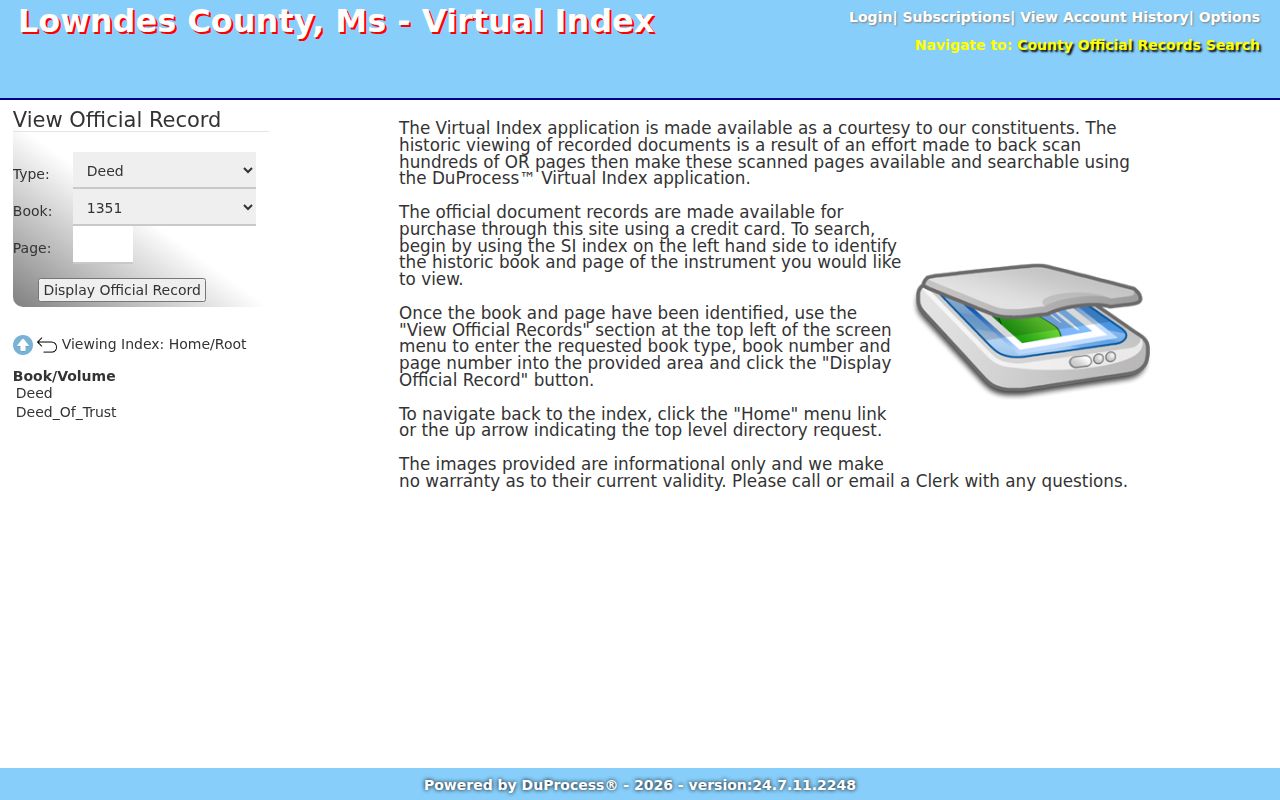
Back-scans can be faint or missing. So the courthouse index stays the final check. The clerk's office sits at 505 2nd Avenue North in Columbus. Mail goes to PO Box 684, Columbus, MS 39703. Counter visits and focused mail requests both work when scans fall short. Hours run Monday through Friday, 8:00 a.m. to 5:00 p.m., and the main number is 662-329-5800. Ask for the index entry first. Do this whenever the book citation is unknown. A narrow request works best. Give the party, an approximate date, the legal description, and a known later deed rather than asking for everything tied to an address.
Reverse the Lowndes Deed Chain
Read every deed backward. The current grantor was usually the prior owner of record. Search that name as an earlier grantee. Confirm the land matches. One person can own several parcels, so check carefully. Divisions, combinations, and rewritten legal descriptions call for a plat or mapping check.
- Find the latest deed from the assessor's book/page reference or current grantee.
- Read the grantor, legal description, deed type, and related instrument references.
- Search that grantor as an earlier grantee and match the same land.
- Repeat until February 2002, then continue through the historic index and deed books.
- Grantor
- The party giving the recorded interest.
- Grantee
- The party receiving the interest.
- Chain of title
- The ordered sequence of transfers tied to the same land.
- Reverse index
- An index arranged to locate parties in their grantor or grantee roles.
- Quitclaim deed
- A transfer of whatever interest the grantor may hold, without the assurances of a warranty deed.
Estate Transfers Break Clean Chains
A deed-only search can lose a prior owner. Estates, trusts, partitions, and court orders all break clean chains. Lowndes Chancery jurisdiction covers estates, land title, land contracts, property division, and injunction matters. The land-record index includes wills, decrees, heirship affidavits, and executor or trustee deeds. Search the deceased owner's name. Search the estate, executor, trustee, and any heirs named in a later deed too. A Chancery case number often supplies the missing authority. The library's local-history indexes help identify older Chancery and Circuit case files. An index entry is only a locator. Confirm the transfer in the court or deed record. Tax and foreclosure deeds deserve equal care. A tax-sale index hit does not prove redemption ended in a completed transfer. Check the Tax Collector's status, the recorded tax deed or release, and the later assessment record.
Legal Descriptions Keep Owners Aligned
Street addresses shift over time. Land descriptions do not. Trace the subdivision, block, lot, acreage, section, township, range, and metes-and-bounds wording from one Lowndes County deed to the next. A parcel split may carry only part of an older legal description forward. A recorded plat shows the new lots and how they sit against the parent tract.
Older Columbus records sometimes need a street-name translation. The Central Commercial Historic District nomination maps Market to today's 5th Street and Washington to 2nd Avenue South. Search both terms. Then compare the historic grid against the current assessor address. In rural Caledonia and Crawford, section-township-range and the PPIN can outperform a mailing town.
A legal description mismatch is a reason to pause. It can signal a different parcel, a partial transfer, an easement, or a mapping error. Ask the Mapping office or Chancery Clerk to reconcile the record rather than forcing the name sequence.
Archive Former Lowndes Owners
The Columbus-Lowndes Public Library anchors local history. Its Billups-Garth Archival Room holds more than 1,000 cubic feet of records. Those cover court, city, school, map, and photo records. The Buckley room adds nearly 1,000 microfilmed newspapers and government records. Together they can explain a house, farm, business, estate, or street name. It may surface in a Lowndes County deed chain.
MDAH's Lowndes finding aid catalogs Series 2050 county records in original and microfilm formats. They run from 1830 through 1980. Historic Resources Inventory entries add construction dates, architects, landmark status, images, and nomination files. Archives give context. They do not certify ownership.
Label every fact with its source. Was it a certified courthouse copy, an online index, or an archival record? Or was it an unresolved clue? The labels matter. That habit keeps a directory entry or nomination narrative from being mistaken for the conveyance itself.
Resolve Gaps in Lowndes History
A blank result is not the end. Retry the name as grantor and grantee. Drop the initials. Try entity variations, and swap the address for the assessor's book and page. Then open Related Items on a known instrument. A correction or assignment there may reveal the missing link.
For an LLC, the Mississippi SOS Business Search offers several paths. Choose Exact Match, Starting With, Sounds Like, officer, or registered-agent. Entity dates may explain a name change. They do not prove parcel ownership. Match the entity to the deed party and the recording date.
If no portal route works, file a public-record request under the Mississippi Public Records Act. Keep it narrow. Name the party, date range, book and page, instrument type, and legal clues. Search, review, copying, and mailing costs may be due in advance.
How Far Lowndes Ownership Goes
Lowndes County's online index reaches back to February 2002. No one year marks the earliest surviving deed. Trace older owners through the historic viewer, courthouse books, recorded plats, Chancery case files, library indexes, and MDAH collections. Stop where the evidence stops. Never turn an archive gap into an assumed owner.
A finished sequence should track transfer type and legal continuity. Sale, gift, quitclaim, executor, trustee, partition, tax, and foreclosure transfers do not mean the same thing. The Lowndes County deed records page covers each deed type and how to get copies. This backward chain stays focused on past owners.
Lawful use. Former-owner research supports house history, estate work, and land diligence. Never use owner information to track, target, or harass a living person.