
Decode Lowndes County Deed Records
The Chancery Clerk files land transfers under many distinct instrument labels. Read the document itself instead of assuming every entry tagged "Deed" is an ordinary sale.
| Deed Type | What It Does | Common Use |
|---|---|---|
| Warranty deed | Conveys the stated interest with covenants | Ordinary sale |
| Quitclaim deed | Conveys whatever interest the grantor may hold | Family transfer or title cleanup |
| Gift deed | Records a transfer given rather than sold | Family or estate planning |
| Trustee / executor deed | Shows a fiduciary transfer under stated authority | Trust, estate, or foreclosure matter |
| Tax deed | Records a transfer tied to a tax sale | Delinquent-tax property |
A deed conveys an interest in land. Deeds of trust, liens, assignments, modifications, releases, and satisfactions instead concern an encumbrance or its current status, so records that sit side by side answer very different questions.
Search Lowndes County Deeds in DuProcess
The DuProcess Official Records Inquiry covers many search paths. Use it to look up parties, dates, instruments, addresses, parcels, and legal descriptions, starting with book/page or PPIN when known and then following grantor and grantee roles through a chain.
| Search group | Verified fields | Purpose |
|---|---|---|
| Party | Grantor, grantee, searched name, cross party | Trace transfers |
| Recording | File date, instrument number, book, page | Retrieve a known filing |
| Land | Subdivision, block, lot, section, township, range | Confirm the same tract |
| Parcel/address | Street, parcel number, Parcel ID, PPIN | Bridge assessor and deeds |
Results carry real detail. Instrument type, description, parties, status, page count, related items, consideration, and legal particulars can all appear, so record every label in your research log.
The official inquiry screen displays these controls:
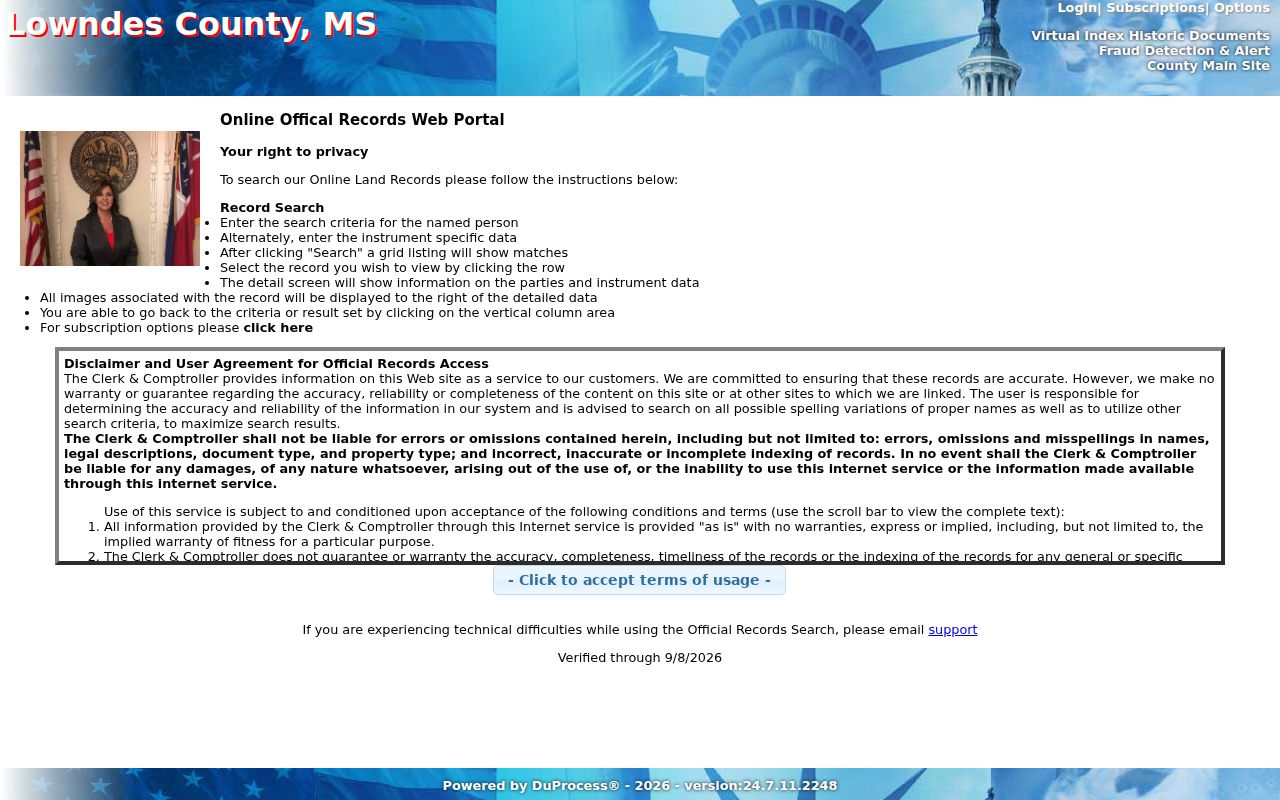
A parcel or legal filter often beats a broad surname search here.
February 2002 Splits Lowndes County Access
The Chancery Clerk page advertises online records from February 2002 to the present. That date is not the start of Lowndes deeds. The courthouse index remains official. Older book/page references belong in the Historic Virtual Index or at the courthouse.
Deeper history sits elsewhere. MDAH Series 2050 holds Lowndes government records from 1830 through 1980. FamilySearch catalogs deed books from 1801 through 1901. Its general indexes run from 1799 through 1920. These help locate material, but neither replaces certification by Chancery.
Note: Log the source date, book/page, legal description, party role, and each unresolved gap before stepping to an earlier transfer.
Walk the Lowndes Grantor-Grantee Index
Start with the newest deed that matches the parcel itself. Confirm the PPIN, address, book/page, and legal description at every transfer rather than trusting the newest record under an owner's name.
- Find the present owner's acquisition deed with that party as grantee.
- Read the grantor, legal description, date, consideration, and related items.
- Search that grantor as an earlier grantee and confirm the same land.
- Repeat through February 2002, then continue in historic books and the courthouse index.
- Grantor
- The party conveying the stated interest.
- Grantee
- The party receiving it.
- Chain of title
- The linked transfer sequence for the same land.
- Book/page vs instrument number
- Two references used to identify a Lowndes filing.
Inspect Lowndes Instruments Around a Transfer
A full pass around each deed checks more than deeds. Look for deeds of trust, assignments, modifications, substitutions of trustee, partial releases, satisfactions, lis pendens, foreclosures, tax instruments, plats, easements, restrictions, and probate filings.
DuProcess also carries specific labels such as Mobile Home Affidavit Of Affixation and Oil Lease/Part Release. The exact label is a lead worth chasing. One cutoff matters here. Delta's Judgment Roll warning notes that state tax liens stopped being filed with the Circuit Clerk. The date was January 1, 2015. Later liens require the state route.
A same-name judgment never proves a lien on a parcel. Match the date, the number, any land description, and the release or satisfaction status before drawing a conclusion.
Translate Historic Lowndes Street Names
Old street names can break a current address search. A Columbus nomination maps Market to present 5th Street and Washington to present 2nd Avenue South. Run both forms. Keep the source wording in your notes.
Rural land leans on other anchors. Section, township, range, acreage, and metes-and-bounds calls often matter more than an address. In platted areas, the subdivision, block, and lot preserve continuity through renumbering. Name and legal description should agree before a deed joins the chain.
Open Older Lowndes County Deed Books
The Historic Virtual Index gives a back-scanned book/page route. It advises trying the searchable index first, and its information carries no warranty.
The viewer displays its search options:
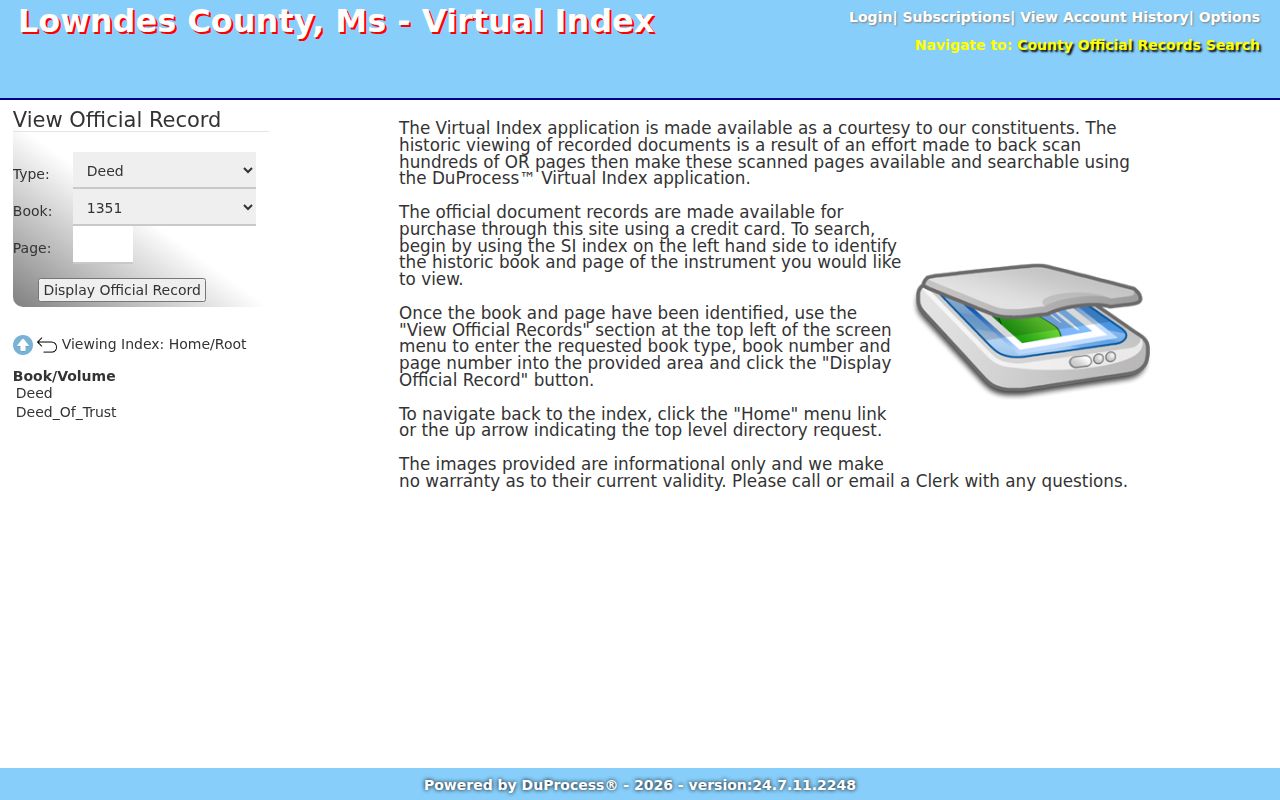
It bridges a citation to an older image, while Chancery remains the official-copy source.
Lowndes County Fraud Alerts Flag New Filings
A June 2026 report described a free Chancery service. Residents register a name and phone number to receive notices of newly recorded documents, and the county Chancery page links the fraud-detection resource.
An alert is a cue, not proof of fraud. Verify the live registration process. Record the instrument number. Then contact the office through its official page if a filing looks unfamiliar.
Request a Lowndes County Deed Copy
Confirm the details first. Parties, date, instrument, page count, and legal description should all be settled before you buy an online image, since the Chancery landing page states that online purchases are final and carry a 3.5% service fee with a $2 minimum. Ask about current plain-copy and certification fees.
The land-record landing page shows the coverage warning and copy path:
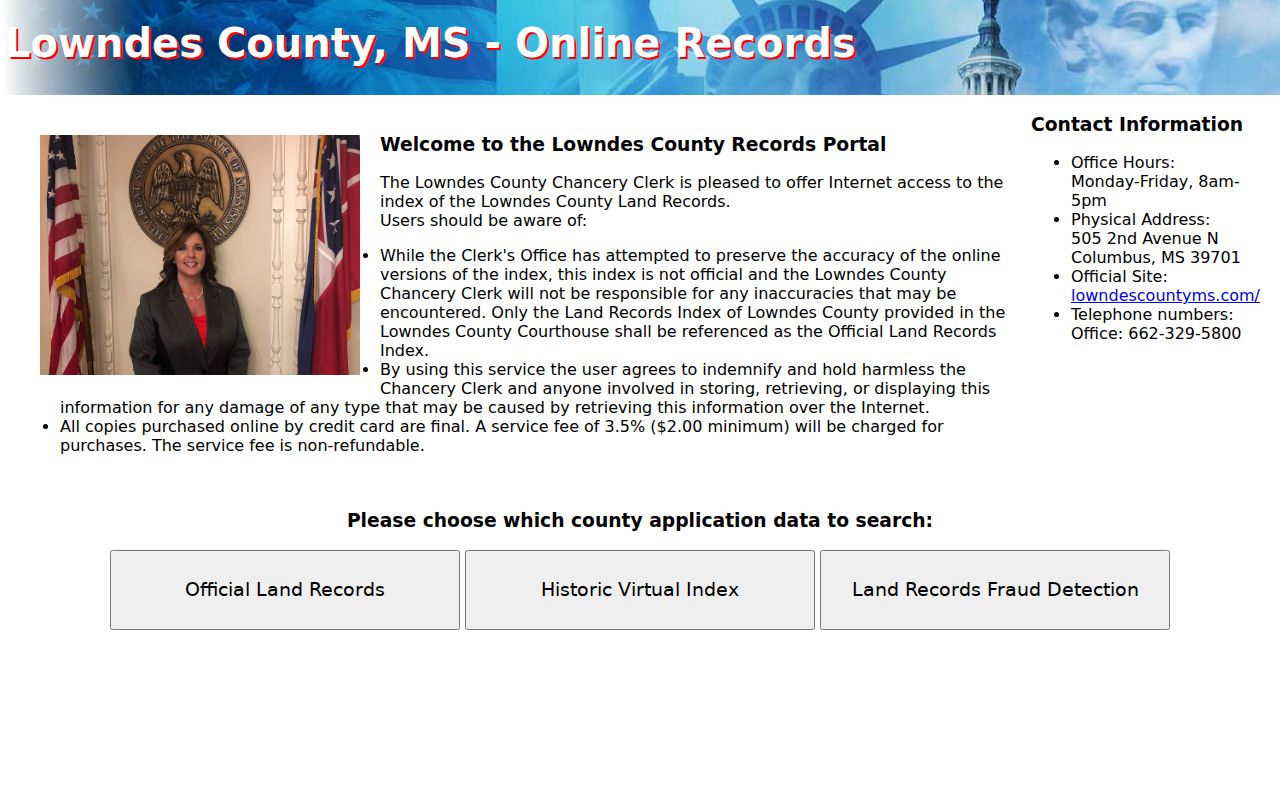
Online access is a convenience. The courthouse index controls. Visit the Chancery Clerk at 505 2nd Avenue North, Columbus, MS 39701, call 662-329-5800 between 8:00 a.m. and 5:00 p.m. Monday through Friday, or mail PO Box 684, Columbus, MS 39703. Give the precise reference and say whether you need certification.
Recorded, not guaranteed. Lowndes County deed records show accepted instruments, not a title opinion, and cannot rule out unrecorded interests. Use official copies and qualified review when legal rights depend on the answer.
Document a Lowndes County Deed Chain
A chain log earns its keep when every transfer gets a row of its own. Record the filing date, grantor, grantee, deed type, instrument number, book and page, and the consideration exactly as labeled. Add the legal-description points. These tie the instrument to the same land. Corrections, releases, plats, probate orders, and tax instruments belong in separate rows. Do not squeeze them into a deed entry. When a name shifts, keep the indexed spelling and note the variant beside it. Trusts, estates, LLCs, married names, and abbreviations cause search gaps far more often than true breaks in ownership. The assessor's DEED BK and DEED PG fields offer a starting citation. Still, the newest recorded grantee is the better check whenever the tax roll lags behind.
Give legal continuity its own column. A split or assembly can change the PPIN. The deed may still carry a parent tract, exception, acreage call, or plat reference. Compare subdivision, block, lot, section, township, range, and metes-and-bounds language first. Only then decide whether two similarly named parcels belong to one chain. Related-item fields repay close study. A correction deed may repair a party name or land description without marking any new sale. A partial release can free just part of the land under an earlier deed of trust. An assignment moves an encumbrance, not the parcel. Write down the stated effect rather than inferring it from the instrument's title. Then look for a later release, satisfaction, substitution, or correction.
Probate and trust transfers can interrupt a plain seller-to-buyer pattern. When a prior owner vanishes from the grantee trail, search wider. Look for wills, decrees, heirship affidavits, executor or trustee deeds, trust instruments, and partition records. Chancery Court handles estate and land-title matters. The Chancery Clerk records land instruments. A court order and the deed executed under it play related but distinct roles. Plats can settle a chain that seems to jump between parcel labels. Chancery filters include Plat and Plat Copies. A recorded plat may show lot, block, dimensions, bearings, and the subdivision scheme behind short deed text. For acreage described by metes and bounds, keep every call and exception. A GIS polygon helps orient the search but cannot fix the recorded boundary.
Keep consideration attached to its label and context. It may reflect a gift, family conveyance, assumption, nominal amount, partial interest, or another non-arm's-length event. It is not automatically market value. The recording date shows when an instrument entered the record, not when possession changed or each contract duty was performed. For a historic cross-check, the Columbus-Lowndes Public Library is a strong stop. It holds court and city material, government-record microfilm, house and town files, and an 1830-1980 people index. MDAH nominations sometimes cite Lowndes deed books directly. These sources add context and leads. But the Chancery courthouse record remains the place to resolve and certify the deed chain.
If DuProcess is unavailable or an image is gated, continue by phone, mail, or at the courthouse. Give staff the instrument number or book and page first. Follow with party names, filing date, and legal description. For an older citation, trace the current deed's backward reference into the Historic Virtual Index or a courthouse book. Asking for one identified plain or certified copy beats a broad surname request. Keep confidence labels beside the evidence. A courthouse-certified copy is not a convenience index entry. An archival reference is not a current official index. When an online name, citation, or description conflicts, mark it unresolved. Ask Chancery to check the official index. Never force a seamless chain by choosing the convenient version. Older research may also require two physical access points. MDAH describes original material for its Archival Reading Room and microfilm for its Media Room. FamilySearch availability can vary by account or location. Note that access limit in the log. A later researcher then knows whether the cited page was inspected or merely identified in a catalog.