
Lowndes County Property Value Types
First, name the number. Lowndes County assessment, deed, and tax records produce figures for different purposes and on different dates. The assessor results show an `Amount` field and nothing like a detail card with a land-and-building split or an annual value history. Never invent fields. The record speaks only for itself.
| Value type | Meaning in the record | Source to check |
|---|---|---|
| True or market value | The value base used before Mississippi's class ratio is applied. | Assessor record or office confirmation |
| Assessed value | True or market value multiplied by the state assessment ratio. | Lowndes Tax Assessor |
| Tax amount or balance | The tax result after millage and account details, not a market estimate. | Tax Collector and payment portal |
| Deed consideration | An amount stated in an instrument that may or may not reflect an arm's-length sale. | Chancery deed detail |
Mississippi keeps the math simple. True value times the ratio gives assessed value. Assessed value times millage produces the tax before other account details. Class I owner-occupied homes use 10 percent. Class II, other real property, uses 15 percent. Deed consideration belongs to a transfer document, so it can reflect a gift, trust, correction, family conveyance, tax deed, or partial interest rather than market price.
Note: Record the exact field label, source, tax year, and date beside every Lowndes County property value.
Read the Lowndes Assessor Amount
The Lowndes Real Property Search accepts a PPIN, PARID, owner, or address. Result headings run from PPIN and PARID through OWNER, ADDRESS, DEED BK, DEED PG, and LEGAL 1. Amount is the value field. That value is informational. It may change. Keep the parcel keys and legal text beside the Amount so a same-name or similar-address result cannot pose as the subject tract.
The alternate Real Property Appraisal search adds year, subdivision, and legal-geography fields to the mix. It shows a form, not a value history.
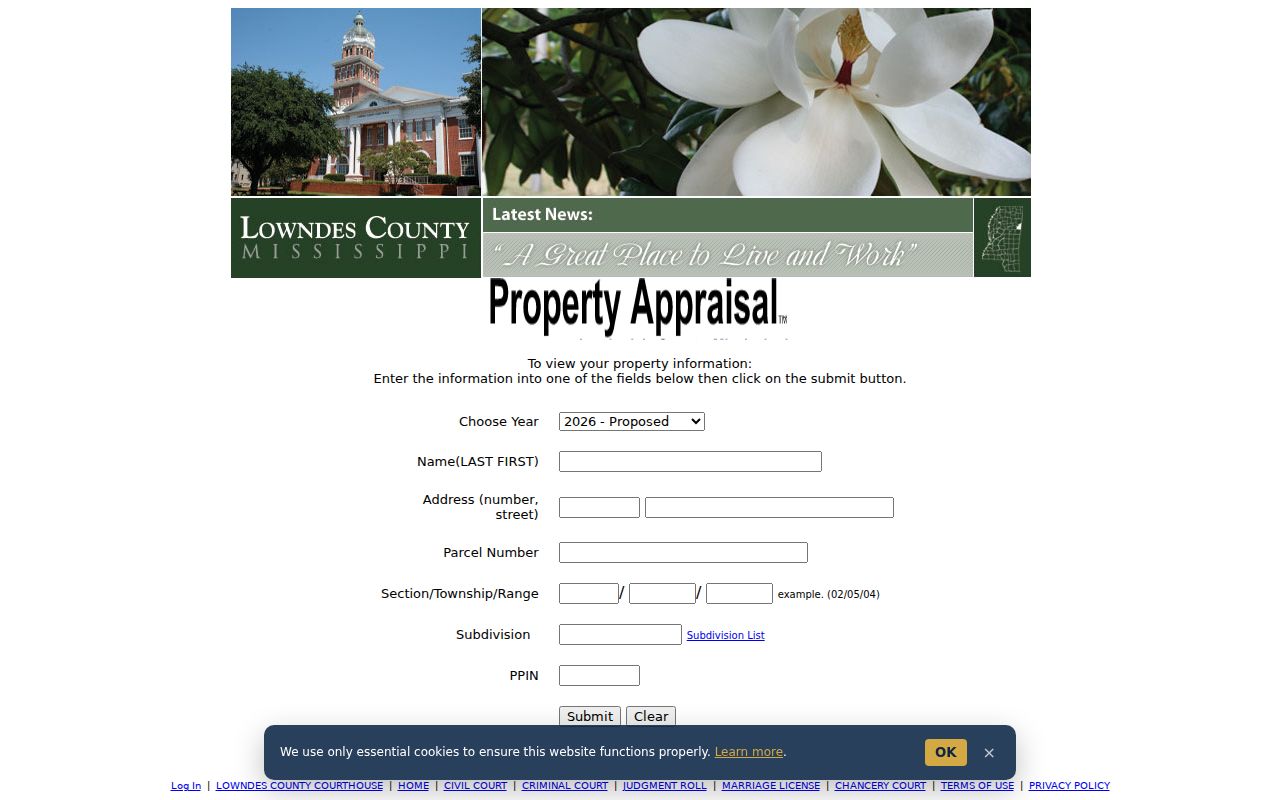
The appraisal form supports a dated property value lookup. It cannot justify an annual trend claim without separate official results for each year.
Calculate Lowndes Assessed Value
The Mississippi Department of Revenue offers a clean illustration. A $100,000 true value at the 10 percent Class I ratio yields a $10,000 assessed value. At 125 mills, the example tax comes to $1,250 before other details. A mill is one-thousandth of the assessed base. That math explains the method, not any specific Lowndes County parcel. Confirm the parcel's class, taxing districts, millage year, and exemptions before computing an expected bill. County, school, city, and special district components differ. Keep the base and the balance apart.
- True or market value
- The assessor's value base under the state system.
- Assessment ratio
- The class percentage applied to true value.
- Assessed value
- The resulting amount to which millage applies.
- Millage
- The tax rate expressed in mills for the relevant jurisdictions and year.
Date Every Lowndes Property Value
Several dates can crowd one parcel. Appraisal year, roll year, deed execution date, filing date, recording date, and tax year all compete. Compare like dates with like fields. A newer deed may precede the roll update. A correction may change a prior tax year without leaving a tidy trend line.
Lowndes County publishes no official parcel card with a full annual assessment and sale series. A defensible comparison uses official values documented separately, each with its year and label. Do not calculate appreciation from one current Amount and an old deed consideration. Verify the transfer type and property extent first.
Parcel changes break simple comparisons too. A split, assembly, corrected legal description, condominium declaration, or partial conveyance can leave the older figure tied to a different land area. Preserve both the former and current PPIN or PARID. Keep the acreage, subdivision description, and deed reference too. Compare values only after confirming both records describe the same property interest.
Look Up Lowndes Property Value
Use PPIN or PARID first. Parcel keys travel more cleanly than names. With only an address, search the number and street, then try common road abbreviations or the street name alone. Confirm the result through its legal description and deed book and page before reading the value field.
- Search the Lowndes assessor by PPIN, PARID, address, or owner. Save the result keys, Amount, and search date.
- Confirm which value the Amount represents and obtain the appraisal or tax year. Contact real-estate appraisal when the label is unclear.
- Use DEED BK and DEED PG in the Chancery index. Read the instrument type and consideration rather than calling every amount a sale price.
- Check the Tax Collector only for the current bill, balance, refund, or payment question. Do not use that figure as market value.
- Assessed value
- The true-value base after application of the property class ratio.
- Market or true value
- The valuation base, not a promise of sale price.
- Deed consideration
- The stated transfer figure, interpreted with the deed type and conveyed interest.
Deed Amounts Need Context
The Lowndes Chancery land index can show deed consideration. Deeds need context. Quitclaim, gift, executor, trustee, correction, partition, foreclosure, and tax deeds can carry amounts that never measured ordinary market demand, so check the type, parties, legal description, acreage, and related items before comparing any figure with an assessed value.
The courthouse index remains the official record. Online land-record coverage is advertised from February 2002 forward. For older material, the Historic Virtual Index and courthouse books are the routes. A certified instrument gives stronger evidence of what was recorded. Even so, a certified deed is not an appraisal.
Note: Match both the parcel and the interest conveyed before treating deed consideration as a useful comparison.
Corrections Shift Lowndes Values
A roll screen can look complete and still miss history. Lowndes County minutes from January 6, 2025 show why. For PPIN 14546, they record prior-year homestead refunds, an exemption deleted in error, and a 2024 reinstatement. That case settles nothing for another parcel. What it proves is simpler: dated office records can resolve what the current display leaves out.
Keep a paper trail when a value looks wrong. Save the assessor result, the notice, the tax year, the exemption filing, the correction request, the refund record, and the final action. The Homestead office answers exemption questions. The Tax Collector handles the bill or refund. Value itself stays separate from that tax administration trail.
Lowndes Value Access Channels
Online access is only the first channel. Search the assessor and Delta appraisal forms, then call real-estate appraisal at 662-241-1997 or Mapping at 662-329-3940 when the parcel, geometry, year, or field is uncertain. The Tax Office at 1121 Main Street in Columbus and 662-329-5700 handles balance and payment questions.
For a deed amount, use DuProcess, Historic Virtual Index, or the official courthouse index and request the relevant instrument. When a non-indexed assessment or correction record is needed, the Lowndes public-record request form provides the county fallback. Describe the PPIN, record, field, and date range narrowly; actual search, review, and reproduction costs may be charged in advance under the stated process.
The online tax payment route is a separate access channel and charges a 3 percent, nonrefundable card service fee. Use it for the account and payment record, not for title or an appraisal. At the office or by phone, ask staff to identify the tax year, valuation field, exemption, district, and correction status behind the figure. Request the dated source record when a past value is essential. That detail prevents a current balance from being reported as the parcel's market estimate.
Limits of Lowndes Property Value
A Lowndes County property value on the roll is an assessment figure inside Mississippi's tax system. It does not say what a buyer will pay. It does not guarantee a building is sound, resolve title, or prove a legal boundary. The tax amount reflects millage and account factors. A deed amount reflects the recorded transfer and may not be an arm's-length sale.
For an independent opinion of market value, use a qualified appraisal. Use a survey for boundaries. Use Chancery records for title evidence. For tax bills and exemptions, see the Lowndes County property tax records page. The appeal route is there as well.
Value versus price. A Lowndes County assessed value supports taxation. It is not a sale forecast or independent appraisal.