
Read Lowndes County Property Tax Records
The record you lead with depends on the question. The Assessor result names the parcel and an informational amount. The payment portal addresses the bill itself. Department of Revenue material explains ratios and millage. Keep those roles separate.
| Field | What It Shows | Where |
|---|---|---|
| PPIN / PARID | Keys the assessment to one parcel | Assessor and Mapping |
| OWNER / ADDRESS | Names and locates the roll entry | Assessor results |
| Amount | Informational tax value, subject to change | Assessor results |
| Tax bill and status | Balance, payment, delinquency, receipt or posting | Tax Collector |
| Ratio and millage | Inputs used to turn true value into tax | Mississippi DOR and current local roll |
A deed consideration amount can be nominal, gifted, partial, or non-arm's-length. None of those equals market value. The tax amount is not market value either, and an assessment record is not a current payoff quote.
Search the Lowndes County Assessment Roll
The Lowndes Real Property Search accepts PPIN, PARID, Owner, and Address. Results expose PPIN, PARID, OWNER, ADDRESS, DEED BK, DEED PG, LEGAL 1, and Amount. Start with PPIN whenever you have it.
| PPIN | Strongest local parcel key |
|---|---|
| PARID | Second parcel identifier to preserve exactly |
| Owner | Name or entity on the assessed roll |
| Address | Useful but vulnerable to abbreviation or renumbering |
The public result offers no detailed value-history card, no land/improvement split, and no separate mailing and situs fields. When a displayed label is unclear, Real Estate Appraisal at 662-241-1997 can explain it. The Real Property Appraisal form supplies an alternate year-sensitive lookup:
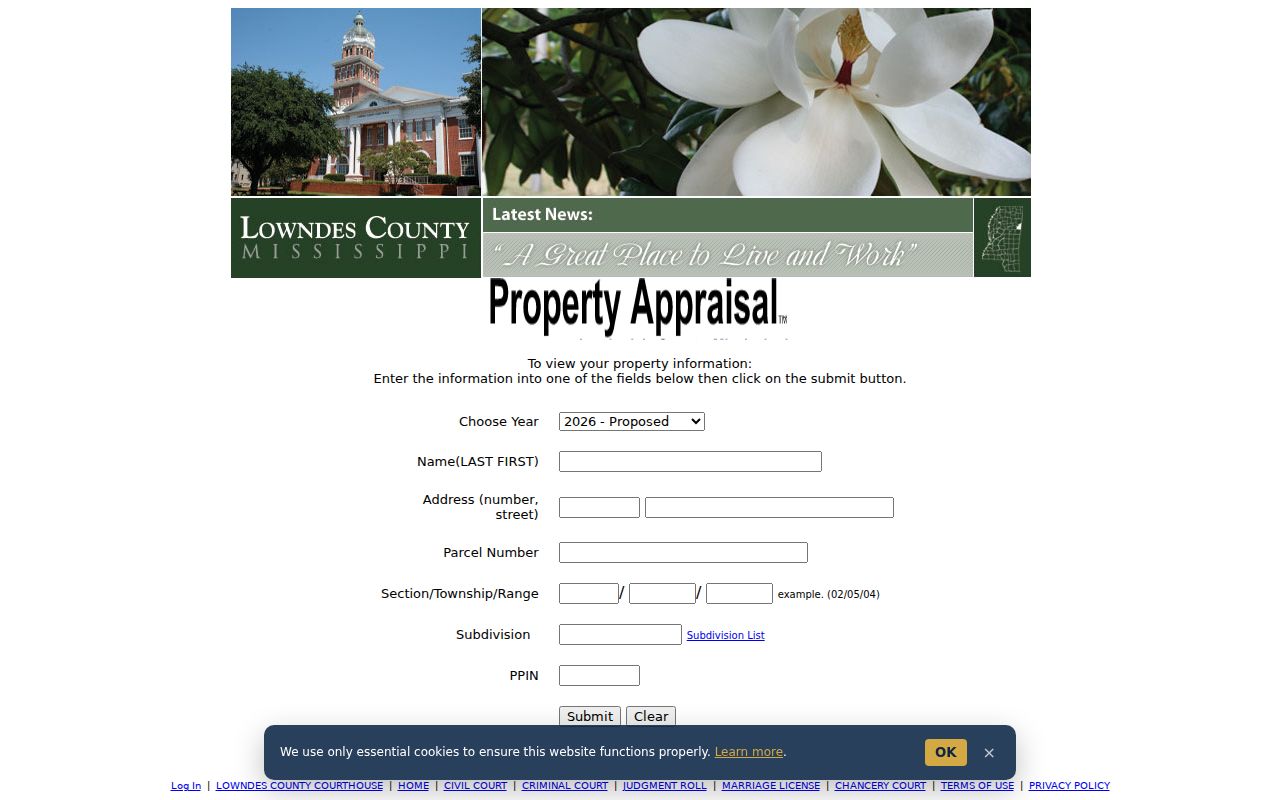
Year and subdivision fields can narrow a Lowndes County assessment search started from an owner or address.
Separate the Lowndes Assessor and Tax Collector
The Tax Office page documents the local contact split. Mapping at 662-329-3940 confirms PPIN and location. Real Estate Appraisal explains the assessment, Homestead at 662-329-5767 handles exemption status, and Tags and Property Taxes at 662-329-5700 answers balance, delinquency, receipt, posting, and refund questions. The offices share 1121 Main Street in Columbus, but their data should not be blended. An assessor warning notes that values are informational and subject to change. The Tax Collector supplies the actual balance.
Look Up a Lowndes County Tax Bill
The online real and personal property tax portal is the county's verified search and payment route. Have the PPIN or parcel reference ready. Also make sure the selected tax year matches the question being asked.
- Find the parcel in the assessor roll and copy PPIN, PARID, address, and owner.
- Open the tax portal and select the matching real-property account and year.
- Read the bill and payment status, then confirm any exemption with Homestead.
- Call the Tax Collector about delinquency, posting, receipt, refund, or tax-sale status.
- Assessed value
- The statutory taxable portion of true or market value.
- Millage
- Tax rate expressed in mills; one mill is one-thousandth.
- Homestead exemption
- Qualified owner-occupied tax relief reflected through the local process.
- Tax lien
- A claim tied to unpaid tax, distinct from the tax bill itself.
The portal states that card payments carry a nonrefundable 3% service fee. The official payment page displays that notice:
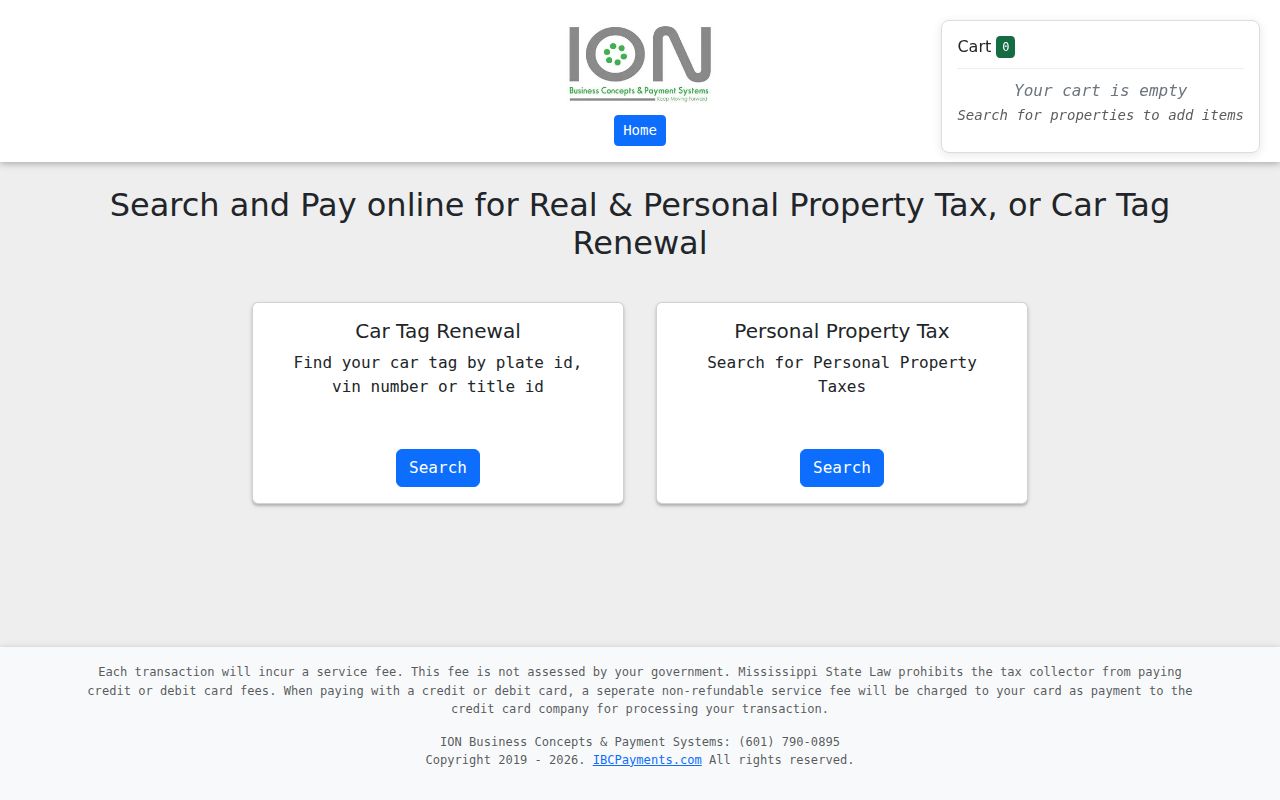
That fee belongs to the card-payment service, not to a free assessment lookup or to the tax itself.
Calculate Lowndes County Property Tax Carefully
The Mississippi Department of Revenue gives the required relationship. True or market value multiplied by the statutory assessment ratio equals assessed value. Assessed value multiplied by millage equals tax. Class I owner-occupied single-family residential property uses a 10% ratio, while Class II other real property uses 15%. DOR's example turns $100,000 of true value into $10,000 assessed at 10%, then into $1,250 at 125 mills before other details. The example explains the math. It is not a Lowndes parcel quote. The DOR property-tax guidance reads as follows:
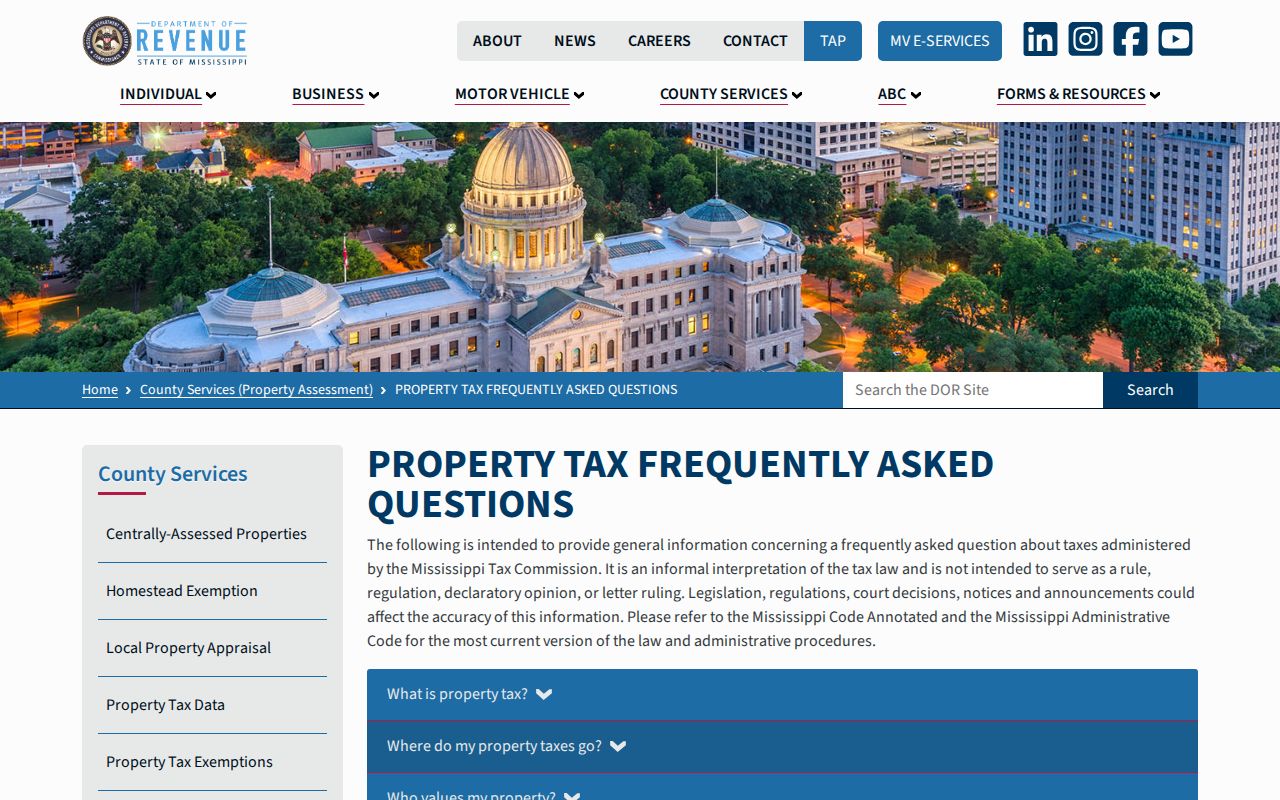
The guidance separates value, ratio, millage, and tax as four distinct items.
File Lowndes Homestead Information on Time
The county FAQ says applications are made at the Tax Collector's office. That window runs January, February, or March. It also says the home must have been bought by December 31. The deed must be recorded by January 7 for the relevant filing. Confirm the current year's dates with Homestead. The same guidance generally does not require yearly reapplication. That holds unless a deed change, disability, or age 65 affects the record. A January 6, 2025 Board of Supervisors minutes item shows why a current screen may not tell the whole story. PPIN 14546 involved refunds for 2022 and 2023. The exemption was deleted in error, then reinstated for 2024. Records can lag reality. Deadlines still apply regardless.
Note: A corrected exemption or refund can change the historical account even when the present-year roll looks complete.
Trace Lowndes Delinquency and Tax-Sale Records
Begin with the Tax Collector for the actual balance, delinquency, and payment status. Then search Chancery instrument types such as County Tax Sale, City Tax Sale, Tax Deed, and Tax Release when the question involves recorded consequences. A tax portal balance does not prove title. A tax-sale-related instrument requires its own legal and date context. Match PPIN, owner, book/page, instrument number, and legal description across every source. For broader parcel lookup mechanics, use the Lowndes County property search guide.
Contest a Lowndes County Assessment
The DOR FAQ says a taxpayer normally files an appeal with the Board of Supervisors by the first Monday in August. The appeal must come before the tax due date. Contact the Chancery Clerk for the hearing procedure. Confirm the deadline on the current notice rather than relying on a prior year's calendar. Gather the assessment notice, the PPIN, correct property characteristics, dated photographs, and comparable evidence. Add deeds or plats that show a parcel error, plus proof of any exemption issue. Real Estate Appraisal can explain the roll first. A value disagreement and a payment-posting problem follow different routes. DOR guidance describes further state review steps when applicable.
Appeal window. Lowndes County owners normally appeal to the Board of Supervisors by the first Monday in August. Verify the current notice and procedure with the Chancery Clerk before filing.
Keep Lowndes County Tax Years in Context
Keep every tax year labeled. Dates answer different questions. Each deserves its own column. The assessment year, bill year, payment date, deed filing date, and viewing date all mean different things. DOR guidance lists millage, exemptions, inflation, economic shifts, and physical changes. These are factors that move the annual result. A difference between two screens needs a label first. The explanation can follow. The county publishes no parcel-level year-over-year value series. So never infer appreciation from a current Amount field, an old map sample, or a deed consideration. Ask Real Estate Appraisal whether an older roll or detailed card exists, and record the office's field names. DOR publishes county and city millage data through 2025. The correct tax district still governs the parcel.
Tax districts explain why similar parcels pay differently. County, school, city, and special-district millage can apply in different combinations. A Columbus mailing address never proves city millage applies. Mail geography and municipal limits are not the same thing. Annexation history can change the answer for a given street. Confirm the district in the current tax record, the assessor or GIS context, and any annexation evidence. Do this before comparing bills. Parcel identity needs the same care. PPIN is the strongest Lowndes County search key. PARID is one check. Deed book and page, legal text, and address serve as others. If a tract was split, assembled, renumbered, or annexed, keep both old and new identifiers. Mapping at 662-329-3940 can connect a current roll entry to earlier parcel references. A deed or recorded plat still controls the legal land description.
Payment status and assessment correctness are separate questions. A card confirmation only shows a transaction was submitted. The Tax Collector should confirm posting, receipt, balance, delinquency, refund, or reversal. The portal's 3% card service fee is nonrefundable. Save the account, year, confirmation, date, and amount whenever paying by card. If a screen does not update at once, call the office instead of sending a second payment. An exemption issue can reach beyond the current year. The documented PPIN 14546 minutes example involved earlier-year refunds, deletion in error, and later reinstatement. It promises no result for another owner. Still, it shows why the application, deed-recording date, eligibility change, roll correction, Board action, and refund record can belong to one tax question. An appeal first needs its category. Wrong acreage, classification, improvement details, ownership date, or exemption may each call for different evidence. Bring the notice and PPIN, name the challenged field. Then ask Real Estate Appraisal what the current procedure accepts. If the issue is what remains owed after assessment, route it to the Tax Collector.
Rebuild the Mississippi formula from the fields for the selected year. Identify true or market value, classification, statutory ratio, assessed value, millage, and any exemption before checking the arithmetic. Class I owner-occupied residential property and Class II other real estate use different ratios. Right math with the wrong class or district still yields the wrong answer. Labels prevent mistakes here too. The March 16, 2026 county agenda mentioned 2025 over-65 homestead changes, audit changes, and refund matters. An agenda proves only that an item was scheduled. Check adopted minutes or the current office rule before stating a change took effect. For office-held history, request a specific tax year, roll entry, correction, refund, or Board record. The county public-record request form warns that search, review, reproduction, and mailing costs may be required in advance. Costs add up fast. A bounded request built on PPIN and year cuts cost and avoids confusion with a similar owner name. For assessed, market, and sale figures without rebuilding the bill, see the Lowndes County property value guide. For any tax question, stay on the actual roll, exemption, millage, bill, payment, correction, and appeal record. Use the record for the chosen year.